Essay · Grow the practice
Marketers on LinkedIn kept asking about my website. I gave their questions to Claude.
Marketers kept pitching fixes for my website, and I could not tell which of their claims were true.
The questions came first
Since I launched Kevin J. Andrews Law LLC in October 2025, marketing professionals have kept writing to me on LinkedIn about the firm's website. They asked whether Search Console was verified and what my analytics showed. Some asked why AI engines didn't name the firm. They also asked about answer engine optimization (AEO) and generative engine optimization (GEO), so I asked Claude to optimize my site for both. I have had at least a dozen outreach messages in the last year.
I didn't hire any of them. I handed their questions, pitches and short audits to Claude as a work list, with one rule. Nothing went live until I approved it from a preview.
The project ran from Sept. 15 to Oct. 24, 2026, about six weeks. When it was done, I asked Claude to price the work as if my firm had bought it from people before AI tools. It estimated 1,009 human-equivalent hours and $126,210 at mid-range U.S. agency and freelancer rates.
Checking the pitch against production
I read each of these messages as a pitch, written to sell a fix. So Claude checked their claims against what the site served.
My analytics had recorded nothing. Claude traced the tags across three containers and three GA4 streams. It removed two containers that weren't mine and installed the correct one.
Claude also set up a scheduled monthly check of the site. It looks for news updates and search tracking results.
The technical layer
Search engine optimization (SEO) aims to get a site ranked. GEO and AEO aim to get it cited when someone puts a question to an AI engine. Most of the plumbing serves all three.
Claude rewrote titles, descriptions, canonical tags and social share cards across about 70 URLs. It built a structured-data graph that tells machines who I am and what each page is. That graph uses the Attorney, Person, BlogPosting, FAQPage, BreadcrumbList, CollectionPage and Dataset types, with links out to my public profiles.
It added a sitemap, robots rules and an llms.txt file written for AI engines. It wired in IndexNow, so search engines that support it get notified of each release the day it ships. It set up Search Console and Bing Webmaster Tools with DNS verification and submitted the sitemap to both.
Smaller fixes followed. The bare domain now redirects permanently to the www address, and retired pages redirect to their replacements. The old chatbot came off the site, and the firm's name now appears the same way on every page. I approved each of these from a preview link before it went live.
Content, and the legal audit behind it
The biggest line in the estimate is writing. Claude drafted or rewrote 48 long-form articles, about 69,000 words, from primary sources. It built three guide hubs. It added answer-first FAQs to four pages, with 42 linked primary-source citations.
It also built a research tracker on the DHS AI Use Case Inventory. The tracker launched Sept. 15. Claude parsed six government spreadsheets, 954 rows in all, into a dashboard with charts and its own structured data.
The second-biggest line is the one I would never hand to a marketer. A wrong sentence on a law firm website is a professional responsibility problem before it is a ranking problem. On my firm's pages, rules that sound alike had to stay separate, each matched to its source.
So Claude built a claim ledger. It checked about 1,150 legal claims across the site against primary sources it had opened, and it marked each one sourced, sourced elsewhere or unsourced. Claude also ran a gray-area audit and logged 303 redline entries, 39 of them critical, with proposed text and sources.
Eight independent checks compared the applied edits against the text I had approved. I approved every legal change myself, in two attorney approval packets.
What the same work would have cost
I asked Claude for an illustrative estimate at typical mid-range U.S. agency and freelancer rates. The figures are estimates from general market knowledge, not vendor quotes, and the hours are human-equivalent rather than tracked time. Nobody billed anybody.
| Work | Hours | Estimated cost |
|---|---|---|
| Content and answer-engine optimization | 414 | $54,200 |
| Legal-accuracy audit against primary sources | 348 | $37,940 |
| Technical SEO and structured data | 82 | $12,180 |
| Discovery, audit and strategy | 48 | $8,200 |
| Conversion and user experience | 60 | $7,990 |
| Release management | 57 | $5,700 |
| Total | 1,009 | $126,210 |
The content line and the legal audit account for 762 of the 1,009 estimated hours. Those are also the two lines where AI changed the economics most, because sourcing about 1,150 legal claims to primary sources is slow work for a human researcher.
Claude estimated the same work would have cost this much across the market before AI tools.
- Freelancers or an offshore team: near $69,400.
- Mid-range U.S. agency and freelancer rates, as in the table: $126,210.
- An established legal-marketing agency: near $189,300.
Claude estimated roughly 8 to 17 weeks for a team of three. It noted that a legal-marketing agency would normally quote 4 to 6 months.
The estimate leaves out my own review time, software subscriptions and any ongoing retainer. It also leaves out link building, directory listings, reviews and PR, none of which has started.
Results are early. Analytics had nothing until the tracking fix went live. None of this work promises rankings or consultations.
A year of proof on LinkedIn
The website results are early. The method behind them has a longer record on LinkedIn. I launched The Global Talent Report there in September 2025, and I built the content system behind it with Claude.
From Sept. 20, 2025, to Oct. 24, 2026, my LinkedIn posts drew 2,257,980 impressions, reached 471,044 members and earned 12,158 engagements. I had 6,498 followers at the end of that stretch.
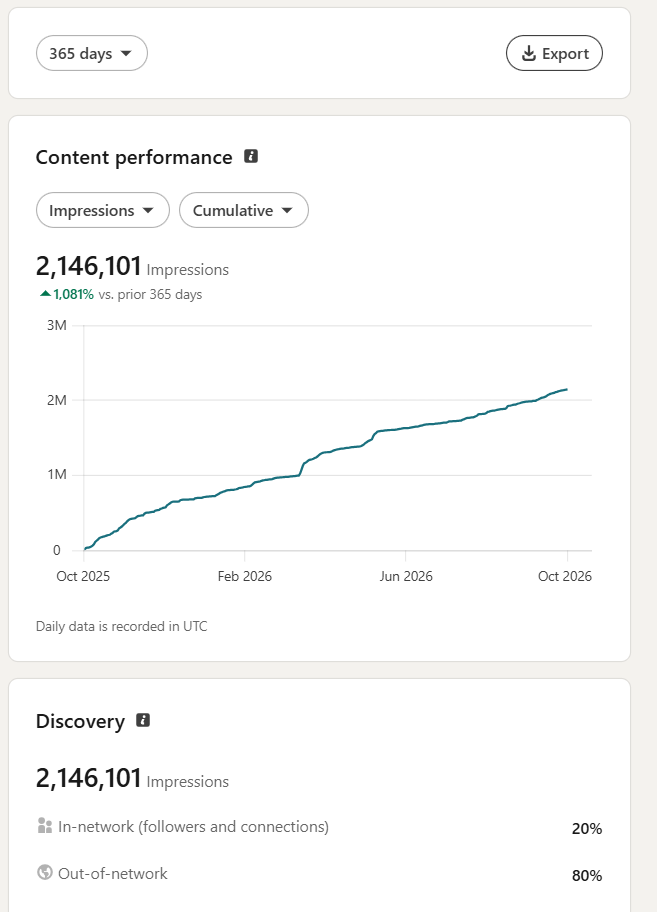
The last 365 days account for 2,146,101 of those impressions, nearly 12 times the prior 365 days by LinkedIn's own comparison. In that year, four of every five impressions came from people outside my network, neither followers nor connections. The two biggest posts, from April 6 and May 30, 2026, drew 150,089 and 104,354 impressions on their own.
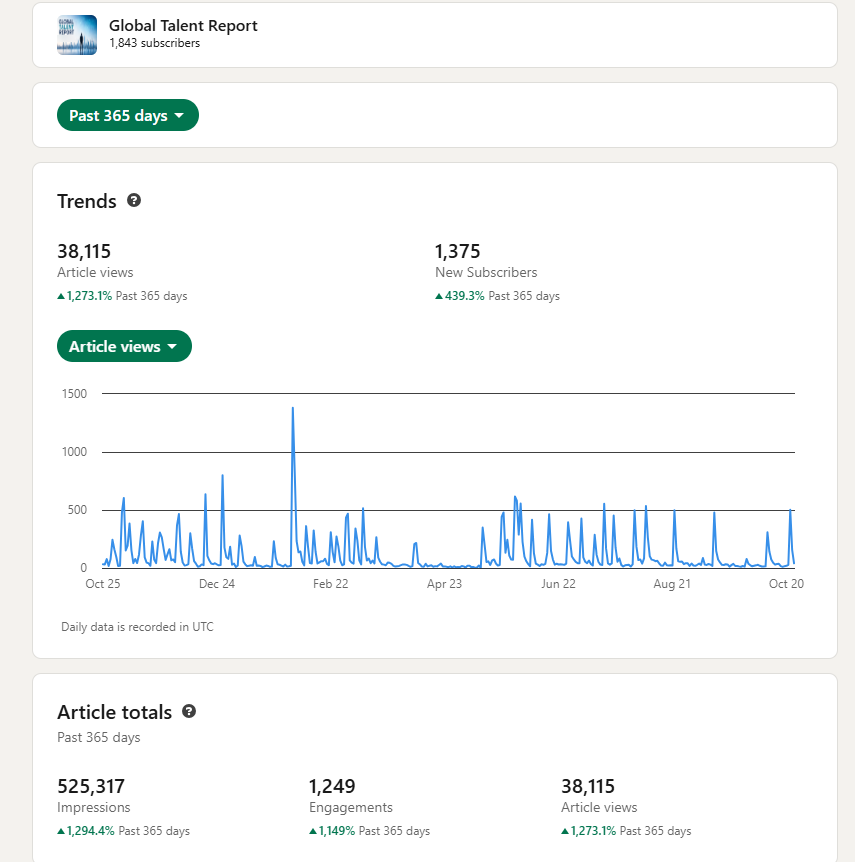
The newsletter grew alongside the posts. Over the same 365 days, The Global Talent Report drew 525,317 impressions and 38,115 article views and added 1,375 subscribers. It had 1,843 subscribers on Oct. 24, 2026.
The audience matched the people I write for. Software engineers, attorneys and founders were the three most common job titles among my followers. IT services and law practice were the top two industries.
The website project ran on the same habits I use for the newsletter, starting from primary sources and ending with my approval.
How to run this on your own site
The method fits in eight steps.
- Save every marketing message, audit and question about your site in one file. Each one is a candidate task.
- Have Claude test each claim against the live site and mark it real, wrong or unclear before anything changes.
- Record a baseline from a fixed list of AI-engine queries. Add Search Console and analytics numbers once they collect data.
- Fix tracking and plumbing before adding new content, so the baseline has data behind it. My analytics recorded nothing until the tracking fix published.
- Write from primary sources. On a law firm site, source every legal claim to the statute, regulation, policy manual or decision.
- Have a separate session compare each applied edit to the text you approved.
- Review a preview of every change before it publishes. My site went through about 30 of those cycles.
- Re-run the baseline each month and compare it to the first numbers.
I stayed in the loop at two points, the attorney approval packets and the preview before each publish. Claude handled the volume. Every decision that carried my license stayed with me.
SolveWork sets up this system for other firms and professionals. The setup does not include legal review. Firms and professionals that use the system are responsible for reviewing its output, maintaining it, and meeting their own ethical duties.
Sources
- IndexNow home page. IndexNow.org. As of October 25, 2026.